The Collateral Damage of Divorce
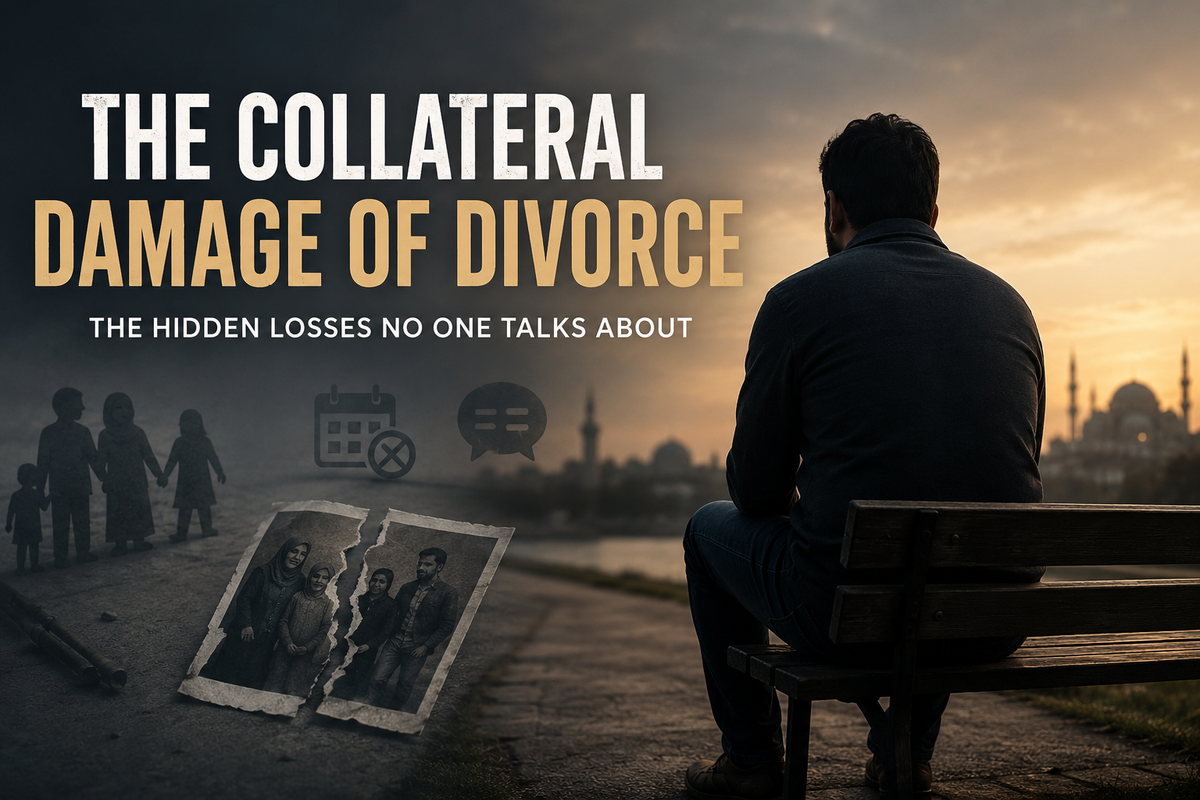
Divorce does not only end a marriage.
It can also damage relationships, routines, friendships, family connections, and a person’s sense of belonging. Many of these losses are not discussed before the divorce takes place. They are only understood afterward.
I call these losses the collateral damage of divorce.
What Is Collateral Damage?
The term collateral damage is commonly used to describe harm caused to something other than the intended target.
In divorce, the marriage may be the relationship that officially ends, but it is rarely the only thing that is lost.
The wider damage can include:
- Losing relationships with in-laws
- No longer being invited to family or community gatherings
- Being judged or shunned
- Losing mutual friends
- Experiencing distance from children
- Feeling uncomfortable at the masjid
- Losing a sense of home and identity
These consequences can affect both men and women. However, the experience of divorced Muslim men is often overlooked.
Losing the In-Laws
One of the most painful consequences of divorce is losing people you considered family.
You may have spent years building relationships with your former spouse’s parents, siblings, nieces, nephews, and extended relatives. You shared meals, Eid celebrations, outings, conversations, and important moments.
Then, almost overnight, those relationships disappear.
There is often no final conversation and no proper goodbye. People who once welcomed you into their homes may no longer speak to you.
It is understandable that relatives will support their own family member. Loyalty is natural. Boundaries may also be necessary after a difficult separation.
But there is still a human cost.
A divorced man may not only be grieving the loss of his wife. He may also be grieving an entire family.
This can be especially painful when the divorce was not the result of abuse, betrayal, or serious wrongdoing. Sometimes a marriage ends despite sincere effort. Sometimes the people involved were not able to resolve their differences.
That does not make the loss any less real.
No Longer Being Invited
Before divorce, you may have been invited to weddings, dinners, aqiqahs, Eid gatherings, and casual family visits.
After divorce, those invitations may stop.
Sometimes this is done to avoid tension. In other cases, mutual friends feel pressured to choose sides. People may assume that inviting both former spouses will create discomfort, so one person is quietly excluded.
Over time, the social circle becomes smaller.
This can feel particularly difficult during Ramadan and Eid. These are times when Muslims gather with family and community. For someone who once had a busy family home, the silence can feel overwhelming.
The divorced Muslim man may find himself eating alone while everyone else appears to be surrounded by family.
That loneliness is part of the collateral damage.
Being Judged by the Community
Divorce still carries a strong stigma in many Muslim communities.
People often want a simple explanation. They want to know who was right, who was wrong, and who should be blamed.
A man who gets divorced may quickly be viewed with suspicion. Some people assume he must have been abusive, irresponsible, unfaithful, controlling, or emotionally absent.
These problems do exist and should never be dismissed.
But it is also unfair to assume that every divorced man is guilty simply because the marriage ended.
Good Muslim men also experience divorce.
Some tried counselling. Some involved elders. Some remained patient for years. Some avoided speaking publicly because they did not want to expose private matters or damage the mother of their children.
Their silence is sometimes treated as proof of guilt.
A person may stay quiet out of dignity, not because he has nothing to say.
The Awkwardness of Mutual Friends
Many mutual friends do not know how to respond after a divorce.
Some avoid both people. Others continue speaking to one person and gradually distance themselves from the other. A few become messengers, carrying private comments between both sides.
Even well-meaning people can make the situation more painful.
They may ask intrusive questions:
“What really happened?”
“Whose fault was it?”
“Are you getting married again?”
A divorced person should not have to explain the most painful chapter of his life to everyone in the community.
Often, the most helpful response is simple.
Treat him normally.
Invite him for coffee. Check in on him. Include him in appropriate gatherings. Do not force him to discuss the divorce. Do not spread rumours or carry stories between households.
He needs friendship, not an investigation.
Losing a Sense of Home
A home is more than a building.
It contains routines, memories, familiar sounds, and a sense of stability. It may be where you raised your children, hosted guests, prayed with your family, and planned your future.
After divorce, that home may no longer be yours.
You may move into a smaller apartment or stay temporarily with relatives. Your children’s belongings may remain somewhere else. Ordinary moments, such as breakfast together or saying goodnight, may disappear.
For a Muslim man who saw himself as a provider and protector, this loss can affect his identity.
He may question whether he failed as a husband, father, or Muslim, even when he made a sincere effort to save the marriage.
The end of the marriage can feel like the end of the life he believed he was building.
Changes in the Relationship With Children
When children are involved, the collateral damage becomes more serious.
A father may go from seeing his children every day to seeing them according to a schedule. Normal parenting becomes something that must be arranged.
He may miss school mornings, bedtime conversations, appointments, family meals, and the small moments that make up family life.
Children can also become caught between two households. They may hear negative comments about one parent or feel pressured to take sides.
This harms them.
Whatever happened between the spouses, children should be free to love both parents without guilt.
A father should not use the children to punish their mother. A mother should not use the children to punish their father.
Relatives and community members should also avoid involving children in adult conflict.
Protecting children requires maturity from everyone around them.
Feeling Disconnected From the Masjid
Divorce can also affect a person’s relationship with the masjid.
A divorced man may feel that people are watching him or discussing his private life. He may worry that members of the community have already chosen a side.
The masjid may also hold painful memories. It may be where the nikah took place, where both families once gathered, or where community members later became involved in the dispute.
At the exact time when a Muslim needs support, he may begin distancing himself from the people and places that once strengthened his faith.
This should concern us.
Divorce may end a marriage, but it should not make someone feel that there is no longer a place for him in the Muslim community.
What the Community Can Do
The collateral damage of divorce cannot always be prevented, but it can be reduced.
Muslims should avoid spreading rumours or making judgments after hearing only one side.
Friends should not disappear simply because a marriage ended.
Relatives should set healthy boundaries without unnecessary cruelty.
Community leaders should listen carefully and avoid assuming that one person is automatically guilty.
Most importantly, divorced people should still be treated with dignity.
A man can be divorced and still be a good father.
He can be divorced and still be a good Muslim.
He can be divorced and still deserve friendship, respect, and support.
Divorce is already painful. The community should not add to that pain.
Final Thoughts
When a marriage ends, the damage rarely remains between two people.
Families divide. Friendships change. Children lose routines. Social circles become smaller. A person may lose his home, his confidence, and his sense of belonging.
This is the collateral damage of divorce.
Much of it remains invisible because divorced men are often expected to remain quiet and move on.
But silence does not mean there is no pain.
We need to speak about divorce with more honesty, balance, and compassion. We need to recognise that there may be suffering on both sides.
Sometimes a marriage ends despite sincere effort.
Sometimes a good Muslim man gets divorced.
And sometimes the deepest wounds come not only from losing the marriage, but from losing everything that was connected to it.
Comments ()