Women & Corporate America - Is it ruining families?

For most women, the corporate workplace is not a natural environment.
There are exceptions, of course. Some women thrive in it. Some women genuinely want that life. There are also fields such as teaching, nursing, and other forms of care-oriented work that are more aligned with the natural fitra of a woman.
But in the conventional corporate structure, a woman often has to use a great deal of masculine energy just to survive. She essentially has to become a man.
She has to compete like a man, communicate like a man, absorb pressure like a man, and prove herself within a system designed around masculine patterns of work. She may become successful in that system, but the success comes with a cost.
The corporate world uses up her energy.
After a long day, she comes home mentally burned out. Her children want her attention. Her husband wants to talk to her. Dinner needs to be made. Bedtime needs to happen. The household still requires emotional presence, patience, affection, and care.
But she has already given most of herself to the workplace.
She becomes edgy. She starts yelling. She is grumpy. She is too tired to participate in bedtime, too tired to cook, and sometimes too tired even to have a normal conversation with her husband.
Then the family begins to suffer.
The woman feels guilty because she is not giving enough at home. She feels exhausted because she is giving too much at work. The husband feels neglected. The children do not receive the attention they need. Everyone becomes frustrated, and the same cycle repeats the next day.
This is often described as a problem of work-life balance, but the issue is deeper than scheduling.
The question is whether the type of work itself is compatible with a woman’s nature, capacity, and responsibilities.
In many households, the woman does not actually have to work. The husband is already making good money and is capable of providing. Yet she still subjects herself to the stress, politics, commuting, competition, and exhaustion of corporate life.
Why?
Part of the problem is that modern society has tied a woman’s self-worth to her position in the corporate structure.
A woman is asked what she does for work. Her job title becomes part of her identity. Promotions, salaries, professional status, and career achievements are treated as signs that she is intelligent, serious, ambitious, and successful.
Motherhood does not receive the same recognition.
A woman who spends her time raising children, managing a home, supporting her husband, and building a stable family is often treated as if she is doing nothing. The work may be exhausting, constant, and essential, but it is not rewarded with a salary or a corporate title, so society acts as though it has no value.
See The Four Burners Theory
 James Clear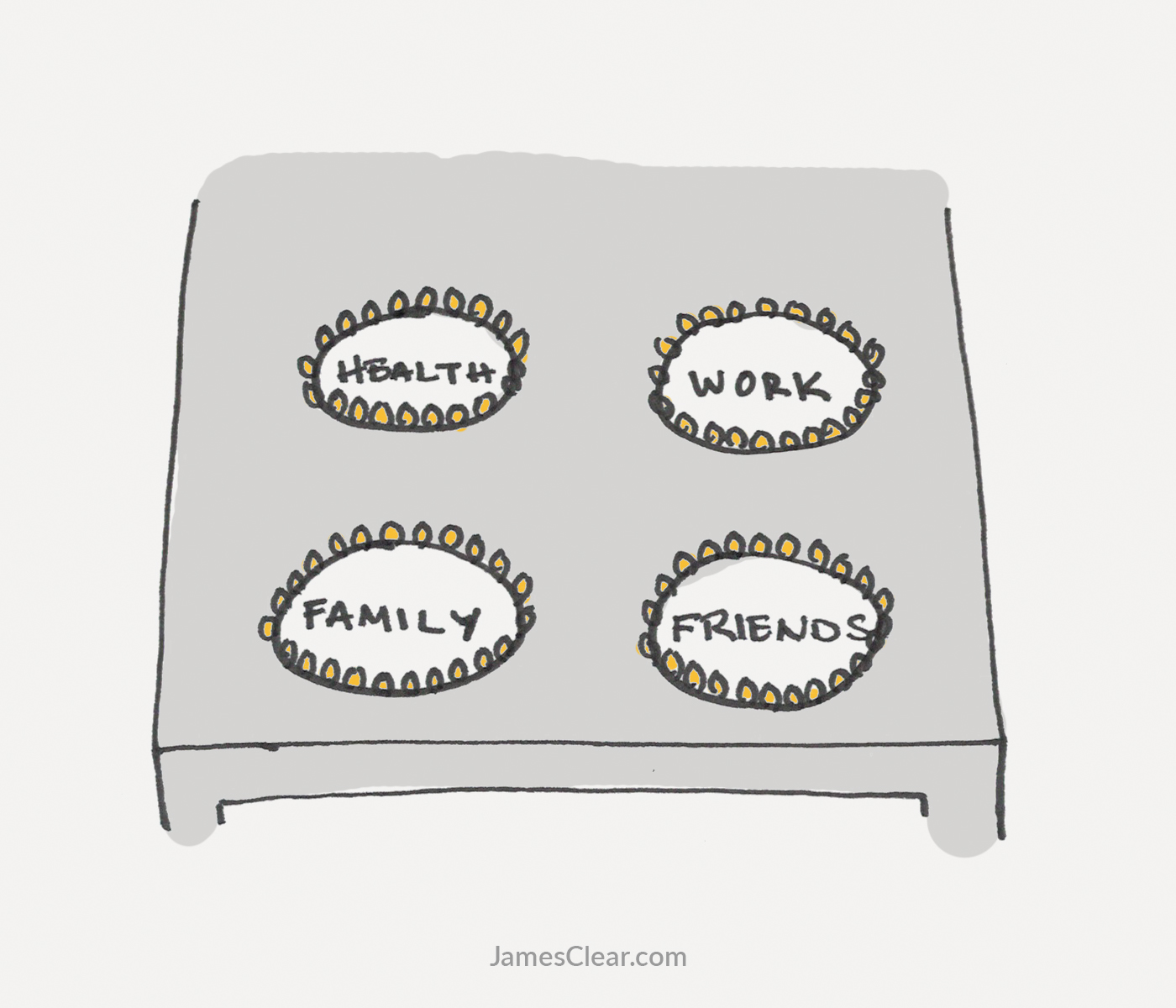
This is one reason women continue working even when they do not financially need to work. Their identity is tied to it.
A useful question is: If a woman had a million dollars, or unlimited money, would she still be doing the job she is currently doing?
In many cases, the answer would be no.
She would spend more time with her family. She might travel. She might create something. She might work in a different way, on her own terms. She might slow down. She might focus on her children while they are young and return to work when they are older.
But instead, she becomes caught in the rat race.
The traditional model did not necessarily mean that women never worked. Women often worked alongside their husbands and families. They contributed to farms, shops, trades, and family businesses. The work was connected to the household rather than separated from it.
The family worked together. They spent time together. The woman did not have to divide herself between a corporation and her home in the same way.
In a traditional Muslim household, the man is responsible for providing. The financial burden, the risk, and the responsibility fall on him. That also means the man has to step up. He cannot demand a traditional wife while refusing to fulfill the traditional responsibilities of a husband.
That is another conversation, but it cannot be ignored.
There are certainly cases where a woman has to work. A family may need the additional income. A husband may be unable or unwilling to provide. A woman may be unmarried, widowed, divorced, or responsible for supporting other relatives.
Those situations are real.
The problem is treating necessity as the model for everyone.
The modern assumption is that every woman should pursue a career, remain continuously employed, climb the corporate ladder, and prove that she can compete with men. Anyone who questions this arrangement is treated as though they want to prevent women from accomplishing anything.
But being a mother is an accomplishment.
Raising children is an accomplishment.
Building a stable household is an accomplishment.
Supporting a family and creating a peaceful home are noble forms of work, even if they do not appear on a résumé.
The Prophet Muhammad (peace and blessings be upon him) said, “Paradise is at the feet of the mother.” (Paradise At Her Feet - IslamOnline)
But the point is that she has to be a mother. She has to do the job. Motherhood cannot remain an abstract title while all of her time, attention, patience, and energy are given somewhere else.
The role has to be valued, and it has to be performed.
Instead, the culture has created the “mommy wars.” Working mothers look down on stay-at-home mothers. Stay-at-home mothers may look down on working mothers. Women begin measuring themselves against one another instead of honestly examining what is best for their own families.
Being a stay-at-home mother is a very noble endeavor, but that nobility has largely been lost in modern culture.
There now appears to be an upward trend in the #tradwife movement, particularly among women who feel that corporate life and modern expectations have not delivered what they promised.
The complaint is not limited to one religion, race, or tradition. Similar frustration can be seen across many households and communities. It may be more visible in metropolitan and urban centers, while parts of middle America continue to maintain a more traditional family structure.
The larger issue is self-awareness.
A woman has to understand her own capacity. She has to recognize the type of energy her work requires and what that work leaves available for her husband, her children, and herself.
That does not mean there is only one arrangement for every woman.
A woman may work before having children. She may stay home while the children are young and return to work later. She may work part-time. She may work remotely. She may build a business with her husband or contribute to a family enterprise.
The arrangement can change depending on the season of life.
But the decision should be made honestly, based on the big picture, rather than on the assumption that corporate work is automatically necessary, empowering, or superior.
Too much emphasis has been placed on work, even when that work is hurting women and their families without them realizing it.
The question is not simply whether a woman is capable of surviving in the corporate world.
She clearly is.
The question is what she has to become in order to survive there, how much of her energy it consumes, and what is left for the people waiting for her at home..
Comments ()